Corsair Nautilus 240 RS ARGB vs Corsair iCUE Link Titan 240: Spec Comparison
As an Amazon Associate we earn from qualifying purchases. Links on this page are affiliate links.
When you compare the corsair nautilus 240 rs argb vs icue link titan 240, you see two distinct cooling approaches from Corsair. Both units are 240mm AIO coolers that support Intel LGA 1851 and 1700, as well as AMD AM5 and AM4 sockets. They share the same core cooling footprint. The main difference lies in their lighting and connectivity. One uses ARGB with direct motherboard connections, while the other relies on the iCUE Link system with standard RGB fans. Your choice depends on your build's wiring and lighting needs.
Key differences
| Aspect | Corsair Nautilus 240 RS ARGB Cooler | Corsair iCUE Link Titan 240 RX RGB White |
|---|---|---|
| Lighting Type | ARGB | RGB |
| Radiator Dimensions | 9.45 x 9.45 x 9.45 inches | 10.9 x 4.72 x 1.06 inches |
| Weight | 2.87 pounds | 2.98 pounds |
| Fan Technology | RS ARGB with AirGuide and magnetic bearings | RX120 RGB fans |
| Connectivity | Direct motherboard connection via daisy-chain | iCUE Link system |
Which one should you choose?
Choose Corsair Nautilus 240 RS ARGB Cooler if
- You want to connect fans directly to motherboard headers without a hub
- You prefer addressable RGB lighting for synchronized effects
- You need a cooler with a slightly lower weight
Choose Corsair iCUE Link Titan 240 RX RGB White if
- You already use the Corsair iCUE Link ecosystem
- You want standard RGB lighting with a simpler control scheme
- You prefer a standard radiator form factor with dedicated link fans
Verdict: The Nautilus 240 RS ARGB suits you if you want direct motherboard connectivity and addressable lighting. The iCUE Link Titan 240 is better if you are invested in the iCUE Link hub system. Both provide equivalent socket support and 240mm cooling performance.
Nautilus 240 RS vs Titan 240 Specs
Lighting Type
The Corsair Nautilus 240 RS ARGB Cooler uses addressable RGB lighting. This allows for complex color patterns and effects on each individual LED. You control it via a motherboard header. The Corsair iCUE Link Titan 240 RX RGB uses standard RGB lighting. This syncs all LEDs to the same color simultaneously. It connects to the iCUE Link hub system. Addressable RGB offers more customization for your build. Standard RGB is simpler to manage. This difference matters for your visual goals.
Fan Technology
The Nautilus 240 RS includes RS120 ARGB fans. These feature Corsair AirGuide technology for directed airflow. They use magnetic dome bearings for durability and low noise. The Titan 240 includes RX120 RGB fans. It does not list specific bearing types or airflow technologies in the data. Both fans support PWM control. The Nautilus fans have defined engineering features. The Titan fans rely on the iCUE Link ecosystem. The Nautilus fans have more specified performance traits.
Pump Noise
The Nautilus 240 RS pump is rated at 20 dBA. This is a whisper-quiet operation level. It circulates coolant efficiently without loud noise. The Titan 240 pump noise level is not listed in the provided data. You cannot compare the acoustic performance directly. The Nautilus has a clear advantage in noise specifications. This matters if you want a silent system. The Titan data lacks this specific metric.
Radiator Dimensions
The Nautilus 240 RS radiator measures 9.45 inches wide and 9.45 inches long. It is a square form factor. The Titan 240 radiator measures 10.9 inches long and 4.72 inches wide. It is a standard rectangular 240mm shape. The Titan is longer but narrower. The Nautilus is more compact in footprint. This affects fitment in different cases. The Titan fits standard 240mm radiator mounts. The Nautilus may require specific clearance checks.
Connection Method
The Nautilus 240 RS supports daisy-chained connections. You can chain fans to one 4-pin PWM header and one +5V ARGB header. This reduces cable clutter. The Titan 240 uses the iCUE Link system. It connects via a proprietary hub. This simplifies wiring but requires the specific hub. The Nautilus uses standard motherboard headers. The Titan uses a proprietary link. Both reduce cable management effort in different ways.
Cold Plate Design
The Nautilus 240 RS features a convex cold plate. This shape ensures maximum contact with the CPU heat spreader. It comes with pre-applied thermal paste. The Titan 240 cold plate design is not detailed in the data. The Nautilus has a specified mechanical advantage for contact. This helps with heat transfer efficiency. The Titan data does not mention this feature. The Nautilus has more specified installation benefits.
Which AIO fits your build needs
Users wanting simple motherboard ARGB control
The Corsair Nautilus 240 RS ARGB connects directly to your motherboard. It uses one 4-pin PWM header and one +5V ARGB header. This daisy-chain design reduces cable clutter. You get addressable RGB effects without needing extra hubs or software. The pump operates at a quiet 20 dBA. This setup is ideal for builds where clean wiring and direct hardware control matter most to you.
Users already using the iCUE Link ecosystem
If you own other iCUE Link devices, this cooler integrates seamlessly. It uses the same connector system for fans and lighting. This means you can manage all your RGB and fan curves from a single hub. The Titan 240 RX RGB fits your existing setup without adding new cables to your motherboard. It is the logical choice for consistency in your system management.
Users prioritizing low-noise operation
The Nautilus 240 RS specifies a whisper-quiet 20 dBA pump. This low noise level ensures your system remains silent during idle or light tasks. The RS120 ARGB fans also feature magnetic dome bearings for durability and reduced noise. If you value a quiet computing environment, this cooler’s acoustic profile is a key advantage over standard AIO options.
The products compared
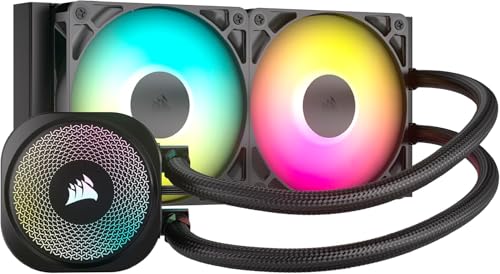
Corsair Nautilus 240 RS ARGB Cooler
Best for: simple ARGB builds with motherboard control
- Radiator Size
- 240mm
- Socket Compatibility
- Intel LGA 1851/1700, AMD AM5/AM4
- Lighting Type
- ARGB
- Dimensions
- 9.45 × 9.45 × 9.45 inches
- Weight
- 2.87 pounds
View on Amazon: Corsair Nautilus 240 RS ARGB Cooler Affiliate link
The Corsair Nautilus 240 RS ARGB is a 240mm AIO cooler designed for low-noise operation and straightforward installation. It features a pump rated at 20 dBA and includes two RS120 fans with AirGuide technology. The unit connects directly to motherboard headers via a daisy-chain system, reducing cable clutter. It supports Intel LGA 1700/1851 and AMD AM4/AM5 sockets. This cooler suits builders who want efficient cooling with minimal wiring complexity.
Pros
- Whisper-quiet 20 dBA pump operation
- Daisy-chained fan connections reduce wiring
- RS120 fans feature AirGuide technology
- Pre-applied thermal paste on convex cold plate
Cons
- Lacks dedicated software control for lighting
- Relies on motherboard ARGB headers only
- No LCD display on the pump head
Good fit if
- You prefer direct motherboard fan connections
- You want low-noise pump operation
- You build with ARGB motherboard headers
Skip if
- You need independent fan speed control
- You require custom lighting patterns
- You want a pump display screen
Verdict: Corsair Nautilus 240 RS ARGB offers clean installation and quiet cooling for users who value simplicity over software customization. It fits builders who connect fans directly to motherboard headers and do not need advanced lighting control.

Corsair iCUE Link Titan 240 RX RGB White
Best for: White builds on LGA 1851 or AM5
- Radiator Size
- 240mm
- Socket Compatibility
- Intel LGA 1851/1700, AMD AM5/AM4
- Lighting Type
- RGB
- Dimensions
- 10.9 × 4.72 × 1.06 inches
- Weight
- 2.98 pounds
View on Amazon: Corsair iCUE Link Titan 240 RX RGB White Affiliate link
The Corsair iCUE Link Titan 240 is a white 240mm AIO cooler designed for Intel LGA 1851/1700 and AMD AM5/AM4 sockets. It includes two RX120 RGB fans for lighting and airflow. The unit measures 10.9 inches in length and weighs 2.98 pounds. You should consider this model if you need broad socket support and integrated RGB lighting in a standard 240mm form factor.
Pros
- Includes two RX120 RGB fans
- Supports Intel LGA 1851 and 1700 sockets
- Supports AMD AM5 and AM4 sockets
- White color finish
Cons
- 2.98 pounds weight may limit case compatibility
- 10.9-inch radiator length requires adequate clearance
- No mention of software control in specifications
Good fit if
- You are building on Intel LGA 1851 or AMD AM5
- You want a white aesthetic for your build
- You need a standard 240mm radiator size
Skip if
- You require a smaller 120mm radiator
- You are using a socket not listed in the specs
- You need explicit software control details in the data
Verdict: Corsair iCUE Link Titan 240 AIO fits builders using modern Intel or AMD platforms who prefer a white 240mm cooler with included RGB fans.
Specifications side by side
| Spec | Corsair Nautilus 240 RS ARGB Cooler | Corsair iCUE Link Titan 240 RX RGB White |
|---|---|---|
| Radiator Size | 240mm | 240mm |
| Socket Compatibility | Intel LGA 1851/1700, AMD AM5/AM4 | Intel LGA 1851/1700, AMD AM5/AM4 |
| Lighting Type | ARGB | RGB |
| Lighting | ARGB | RGB |
| Dimensions | 9.45 × 9.45 × 9.45 inches | 10.9 × 4.72 × 1.06 inches |
| Weight | 2.87 pounds | 2.98 pounds |
| Model | CW-9060092-WW | not stated |
| Size | not stated | 240mm AIO |
| Color | not stated | White |
Frequently asked questions
Does the Corsair Nautilus 240 RS ARGB support LGA 1851 sockets?
Yes, the Corsair Nautilus 240 RS ARGB supports LGA 1851. It also works with AM4, AM5, and LGA 1700 platforms. This compatibility ensures you can use it on modern Intel and AMD systems without needing separate mounting hardware for each socket type.
What is the weight difference between the two coolers?
The Corsair Nautilus 240 RS ARGB weighs 2.87 pounds. The Corsair iCUE Link Titan 240 RX RGB White weighs 2.98 pounds. The Titan is slightly heavier by 0.11 pounds. This minor difference rarely impacts installation or case support in standard PC builds.
Can I control the lighting on the Nautilus 240 RS via motherboard?
Yes, the Nautilus 240 RS ARGB uses addressable RGB lighting controlled by a motherboard header. You connect it directly to a +5V ARGB pin on your board. This allows for synchronization with other motherboard-connected components without requiring additional software hubs or controllers.
Is the iCUE Link Titan 240 available in white?
Yes, the Corsair iCUE Link Titan 240 RX RGB White is available in white. This color option fits builders who prefer a clean, monochromatic aesthetic. It includes RGB fans that complement the white radiator and pump block design for a unified look.
What dimensions should I check for case compatibility with the Titan 240?
The Corsair iCUE Link Titan 240 measures 10.9 inches in length, 4.72 inches in width, and 1.06 inches in height. These dimensions ensure it fits standard 240mm radiator slots in most mid-tower and full-tower cases. Always verify your case supports this specific radiator size before purchasing.
Does the Nautilus 240 RS come with ARGB or standard RGB fans?
The Corsair Nautilus 240 RS ARGB Cooler comes with ARGB fans. Addressable RGB allows for individual LED control, enabling complex color patterns and effects. This differs from standard RGB, which colors all LEDs simultaneously. You manage these effects through your motherboard software.
Which cooler is better for a simple build with minimal cables?
The Corsair Nautilus 240 RS ARGB is better for simple builds. It connects directly to motherboard headers using a daisy-chain design. This reduces cable clutter by eliminating the need for separate hubs or controllers. You get quiet cooling and clean installation with fewer connections to manage.
Do both coolers support AM5 sockets for Ryzen processors?
Yes, both the Corsair Nautilus 240 RS ARGB and the iCUE Link Titan 240 support AM5 sockets. They also support AM4, ensuring backward compatibility with older Ryzen CPUs. This makes either option suitable for current AMD platforms or previous generation systems using the same socket type.